Answer four quick questions to see resources that may fit. This tool
does not diagnose your child or decide eligibility.
FAMILY TOOLKIT
Everyday answers, one topic at a time.
Tap a picture for simple steps, questions to ask and trusted places
to learn more. Nothing here replaces your child’s doctor, lawyer or
benefits specialist.
FAMILY TOOLKIT · SAFETY · ELOPEMENT / WANDERING
Wandering safety: one step at a time.
These practical steps can help if an autistic child, a nonspeaking child or a child with limited speech leaves home, school, transportation, camp, therapy or another supervised setting unexpectedly. GPS is an extra safety layer, not a replacement for supervision or an emergency plan.
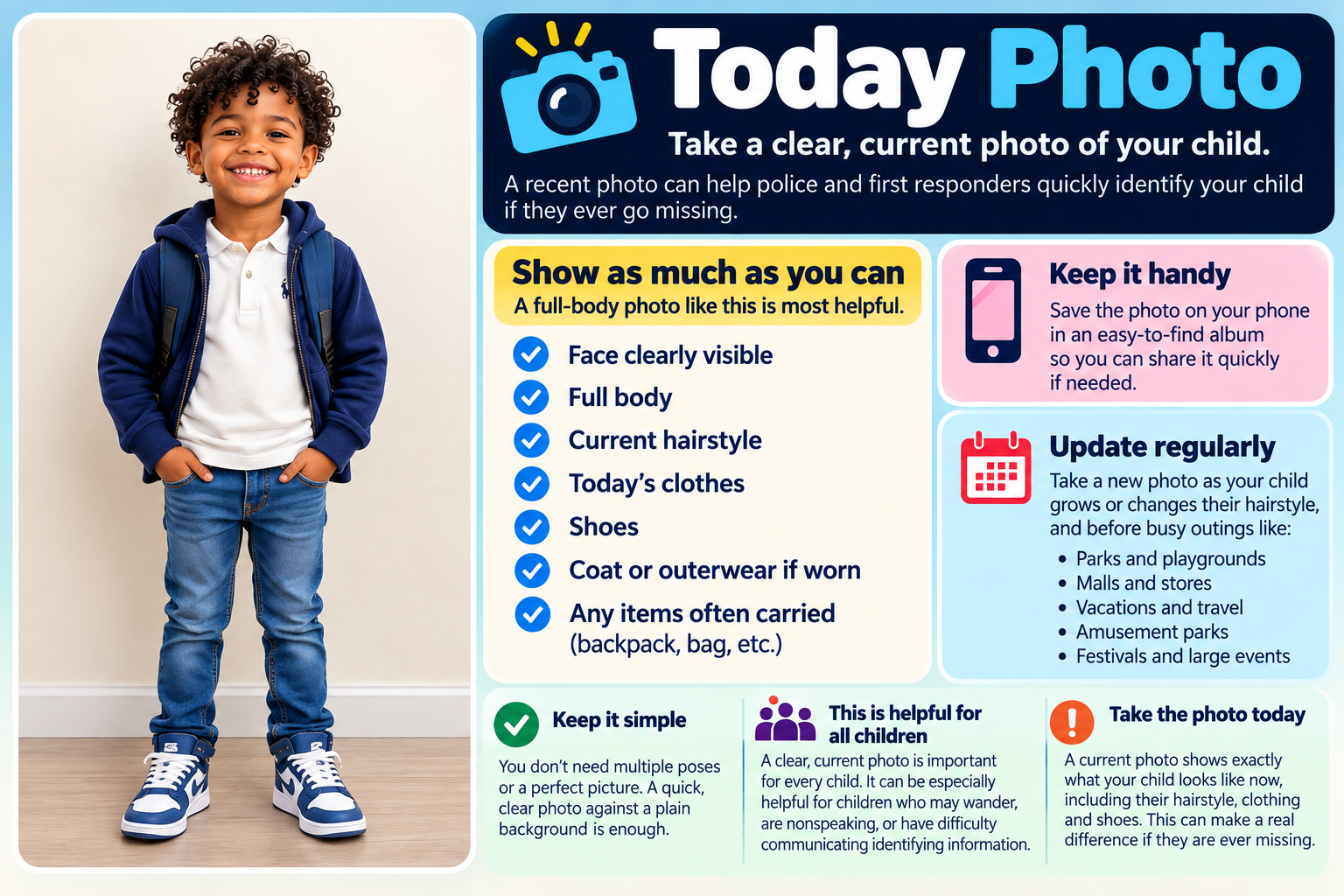
One clear, full-body photo makes today’s appearance easy to share.
What to do now
Take a quick photo before leaving and keep it easy to find on your phone.
Show details
A 30-SECOND DAILY ROUTINE
Take a “Today Photo” before your child leaves home
One good current photo is enough. A quick full-body phone photo is useful for any child, especially one who may wander, be nonspeaking or have difficulty sharing identifying information. No professional shoot, headshot or multiple poses are needed.
Before school, therapy, camp, transportation or an outing, take one quick photo showing what your child looks like and is wearing today. It does not need to be a perfect portrait.
“If my child went missing today, could I immediately hand this photo to police and clearly show what my child looks like and what they are wearing right now?”
Use bright lighting and a plain or consistent background.
Face the child forward—or mostly forward—with the full face visible.
Step back enough to show the child from head to toe, including shoes.
Show the current hairstyle, shirt or top, pants, shorts or skirt.
Include a backpack, coat, glasses, hat, headphones, jewelry or other noticeable items.
Do not use filters.
Cold-weather tip
Include the coat or outerwear if worn and make the face, shoes and current outfit as clear as you can in one photo. If a coat hides the clothes underneath, note what your child is wearing; an extra photo is optional, not required. Save the photo where you can find it quickly and update it when your child’s appearance changes.
Face visibleFull bodyShoes visibleToday’s outfitBackpack visibleBright lighting
Not as helpful: blurry, too dark, cropped head, turned-away face, close-up only or an old photo.
Choose an ID your child can comfortably keep with them.
What to do now
Check that a caregiver and backup phone number are readable.
Show details
A child who is nonspeaking or has limited speech may not be able to give their name, caregiver’s name, address, phone number, school or explain that they are lost.
Consider a medical ID bracelet, silicone ID band, shoe tag, backpack ID, laminated wallet card, inside-pocket card, discreet emergency tag or identification written or sewn inside clothing.
Example
My name is Alex. I am nonspeaking. I may not respond to questions or my name. Please stay with me and call: Mom: xxx-xxx-xxxx Dad: xxx-xxx-xxxx
Include only what is useful: first name, communication information, autism disclosure if the family chooses, caregiver phone number and a backup contact.
Protect privacy: Do not publicly display a full home address, Medicaid or insurance number, school ID or other unnecessary sensitive information. Keep more detail privately inside a jacket, backpack, wallet card or emergency profile.
A coat can come off. Keep identification in a second place too.
What to do now
Check the inside label and a separate band, shoe tag or card.
Show details
Use a sewn label, fabric marker on the interior tag, iron-on label, inside-pocket emergency card or discreet QR/emergency tag if appropriate.
A child may remove the coat, so keep identification in another place too—for example on a medical ID band, shoe tag or securely attached backpack card.
STEP 4
Check your tracking layer
Tracking can help locate a child; it does not prevent wandering.
What to do now
If you use a tracker, check its charge, attachment, connection and alerts.
Show details
GPS TRACKERS FOR CHILDREN WHO WANDER OR ELOPE
Use tracking as one layer of a larger safety plan
A GPS device can help with a child who may not respond to their name or who may leave unexpectedly. Check battery, cellular coverage, attachment and app connection every day. No tracker prevents wandering or guarantees recovery.
FEATURED DEDICATED OPTION
AngelSense
AngelSense is designed for people with autism, special needs or dementia. Current manufacturer information lists continuous real-time GPS, unlimited guardians and geofences, caregiver alerts, transit monitoring, daily timeline history, 1-way listening, 2-way auto-answer voice, remotely activated alarm, sensory-friendly and secure attachment options, and iPhone, Android and web access.
Live sharing: a caregiver can send a temporary live-location link by text or email to law enforcement, search-and-rescue, school staff, family or caregivers. The recipient does not need the app.
First Responders: a caregiver can activate a predefined group that receives temporary read-only tracking access. AngelSense does not automatically dispatch police—the caregiver shares information and should call 911 in an emergency.
2-way voice: a caregiver may speak to the child, let a speaking child respond, let a nonspeaking child hear a familiar voice or speak to an adult who finds the child.
“Hi, I’m her mother. She is autistic and may not be able to answer your questions. Please stay with her. I am on my way.”
ACTIVE WANDERING SAFETY
AngelSense
Strengths: real-time GPS, safe zones, alerts, 1-way and 2-way voice, temporary live sharing and First Responder tools.
Subscription: Yes.
LOW-COST BACKUP / ITEM AID
Apple AirTag
Uses Apple’s Find My network and supports nearby Precision Finding on compatible Apple devices. More than one year of replaceable-battery life; $29 for one at time checked.
Limits: Designed for items—not a dedicated person GPS tracker. No 2-way voice or continuous live GPS. Useful only as a backup/location aid.
Bluetooth tracker that can ring nearby and may update through the Tile/Life360 network. Current Tile Mate works with iOS and Android and lists up to three-year battery life; single tracker was $24.99 at time checked.
Limits: No dedicated continuous live GPS and no 2-way voice. Better as a backup than for active elopement tracking.
Subscription: Not required for basic finding; optional memberships may add services.
Real-time GPS, Wi-Fi, cellular and Bluetooth; geofences, notifications and location history.
No 2-way voice. Caregiver/location sharing is supported; no public law-enforcement live-link feature verified.
Manufacturer comparison lists up to 30 days; water-resistant.
Secure loop, hem lock, strap clip, sleeve and pin-lock pouch options.
iPhone + Android. Site displayed $99.99 sale price; subscription required and official comparison listed plans from $8.33/month equivalent. Last verified: September 2026.
Real-time location, route history, SOS and caregiver app alerts.
2-way voice/video and approved contacts. No AngelSense-style law-enforcement live-link feature verified.
Up to 48 hours normal use / 100 hours standby; IP67 water resistance.
Wristwatch.
iPhone + Android caregiver app. $159.99 and cellular plans from $9.99/month, but the manufacturer marked TickTalk 5 sold out when checked. Last verified: September 2026.
Prices, promotions, service plans and device availability can change. Confirm the total device, accessory, activation and monthly cost directly with the manufacturer before buying.
STEP 5
Know who to contact
Keep communication needs and emergency contacts ready, privately.
What to do now
Save caregiver and backup numbers. In a missing-child emergency, call 911.
Show details
Keep a recent photo plus the child’s full name, age, height, approximate weight, hairstyle, communication information, whether they respond to their name, sensory needs, calming strategies, favorite places, common wandering destinations, emergency contacts and important safety or medical information.
This profile does not need to be public. Share only what responders need during an emergency.
School, transport, camp and therapy need the same clear plan.
What to do now
Ask who calls, who searches and how transitions are supervised. Record names, dates and agreed steps.
Show details
Give school, transportation, camp, therapy and respite staff a current emergency contact, communication information and the child’s individualized elopement plan. Ask who calls 911, who searches, who contacts the caregiver and how doors, transitions and arrival/dismissal are supervised.
Checklist stays in this browser on this device. No account needed. It is not sent to CalAsh.
AGES 14–21 · START BEFORE 18
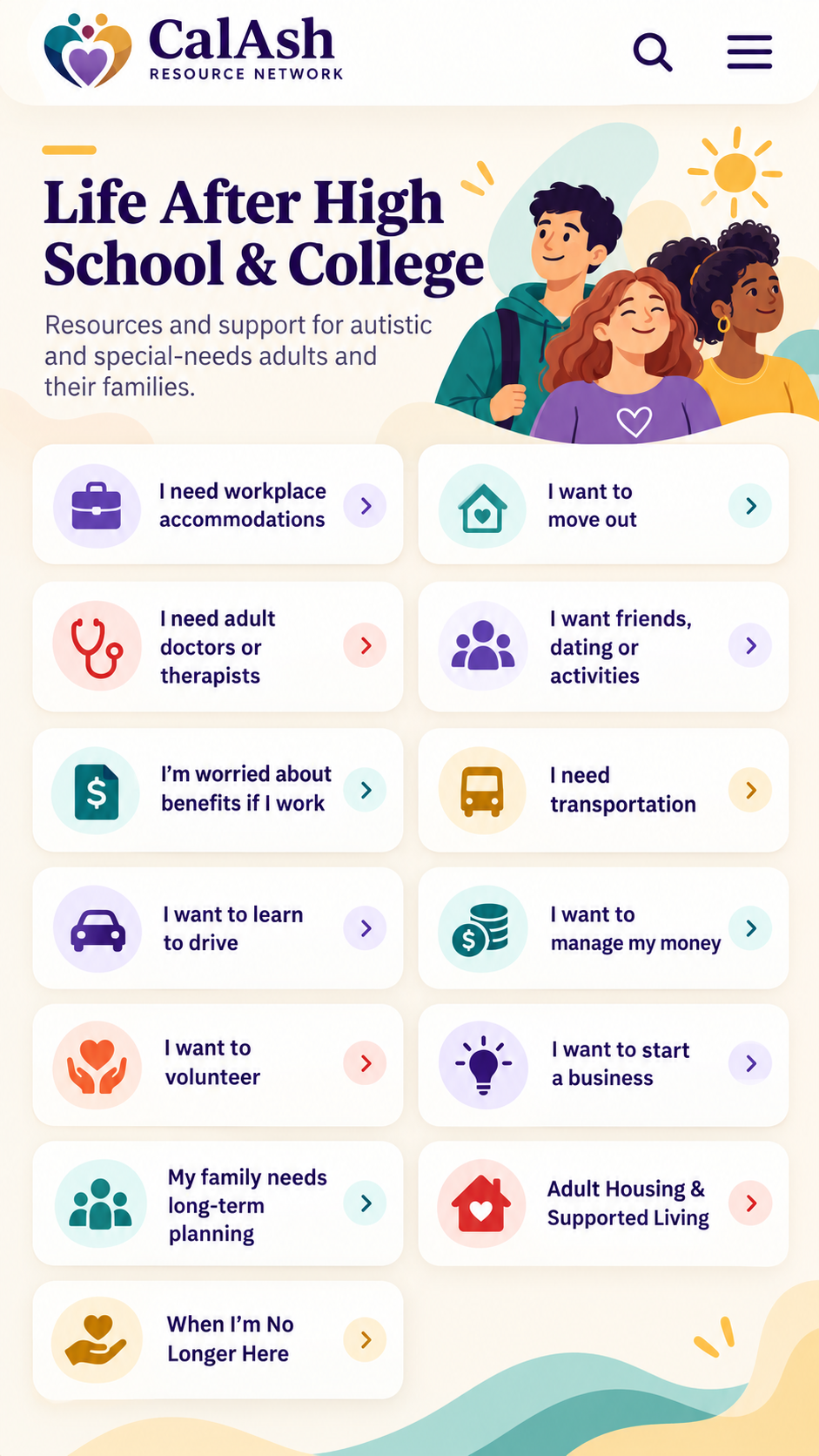
Plan for adulthood one step at a time.
Turning 18 changes who can make decisions and how some benefits are reviewed. Families do not need to solve everything at once, but starting early prevents rushed choices.
By age 15: put transition goals in the IEP
Ask for goals tied to communication, daily living, travel, safety, work, further education and community life. New York schools should begin transition planning by age 15 or earlier.
Ages 16–17: compare decision-making options
Learn about supported decision-making, health-care proxies or powers of attorney when appropriate, and guardianship only when a less restrictive option will not meet the person’s needs. Speak with a qualified New York professional about your child’s situation.
Before 18: review benefits and adult-service steps
Ask about SSI’s age-18 disability review, Medicaid, OPWDD eligibility and services, ACCES-VR, adult health care and school services through age 21. Keep evaluations, IEPs, benefit letters and identification together.
Family protection: plan money and care carefully
Do not leave money directly to a person receiving needs-based benefits without advice. Ask a New York special-needs-planning attorney about third-party, first-party or pooled trusts, an ABLE account, beneficiary choices, a Letter of Intent and who can step in during an emergency.
Estate and backup planning: name the people who can step in
Review wills, beneficiary designations, trustees, successor trustees, backup caregivers and emergency contacts with qualified New York professionals. Make sure the people you name understand the role and know where current records are kept.
Family care guide: write down what another caregiver needs to know
Create a practical guide with communication methods, routines, sensory needs, calming strategies, food and sleep needs, medications, doctors, school or program contacts, benefits information, safety risks, legal documents and what brings your child comfort. Update it at least once a year and whenever care changes.
Important: This is general education, not legal or financial advice. A lawyer should explain the choices without assuming every disabled person needs guardianship.
MORE SUPPORT OPTIONS
Find help for children with higher support needs.
Use these choices if your child is nonspeaking, has an intellectual
disability, needs help with daily activities or requires close
supervision.
Communication includes more than speech. A child may
communicate through behavior, gestures, movement, eye gaze, pictures,
AAC or changes in routine.
AGES 3–5 · PRESCHOOL SPECIAL EDUCATION
Find a 4410 preschool program.
4410 programs are approved by New York State for preschool children
with disabilities. Your child’s CPSE team uses the IEP process to
recommend services and a placement.
Questions to ask: Is the classroom open year-round? How many students and staff are in the room? Can staff support AAC, high activity, elopement, toileting, feeding, behavior or nursing needs? Ask to visit and request the current program list for your area.
🧩🧩🧩
SPECIAL-EDUCATION SCHOOL FINDER
Find a school that may fit your child.
Choose an area and school level to see programs in New York City,
Nassau, Suffolk, Westchester, Rockland, Putnam, Orange and northern New Jersey.
Before you choose a school: Ask the school and your district
about eligibility, openings, class size, staffing, communication,
behavior and safety plans, nursing and help with daily activities.
In New Jersey, a public district child study team and IEP determine eligible placements. Approved private schools for students with disabilities and county programs generally receive district referrals; a listing here does not mean direct enrollment or a family tuition bill. Ask the district about transportation and extended school year when the IEP calls for them.
Check the NJDOE approved school directory.
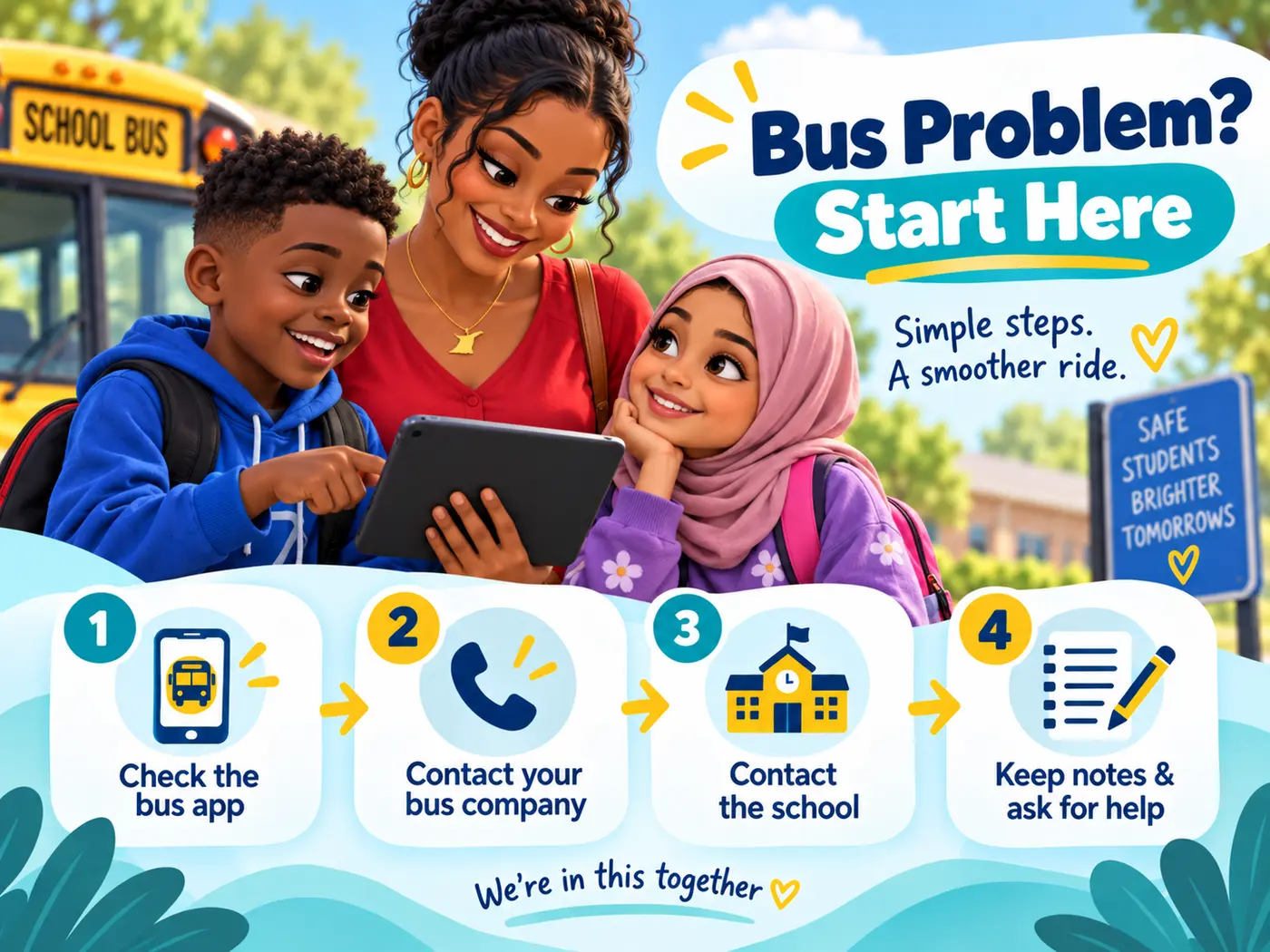
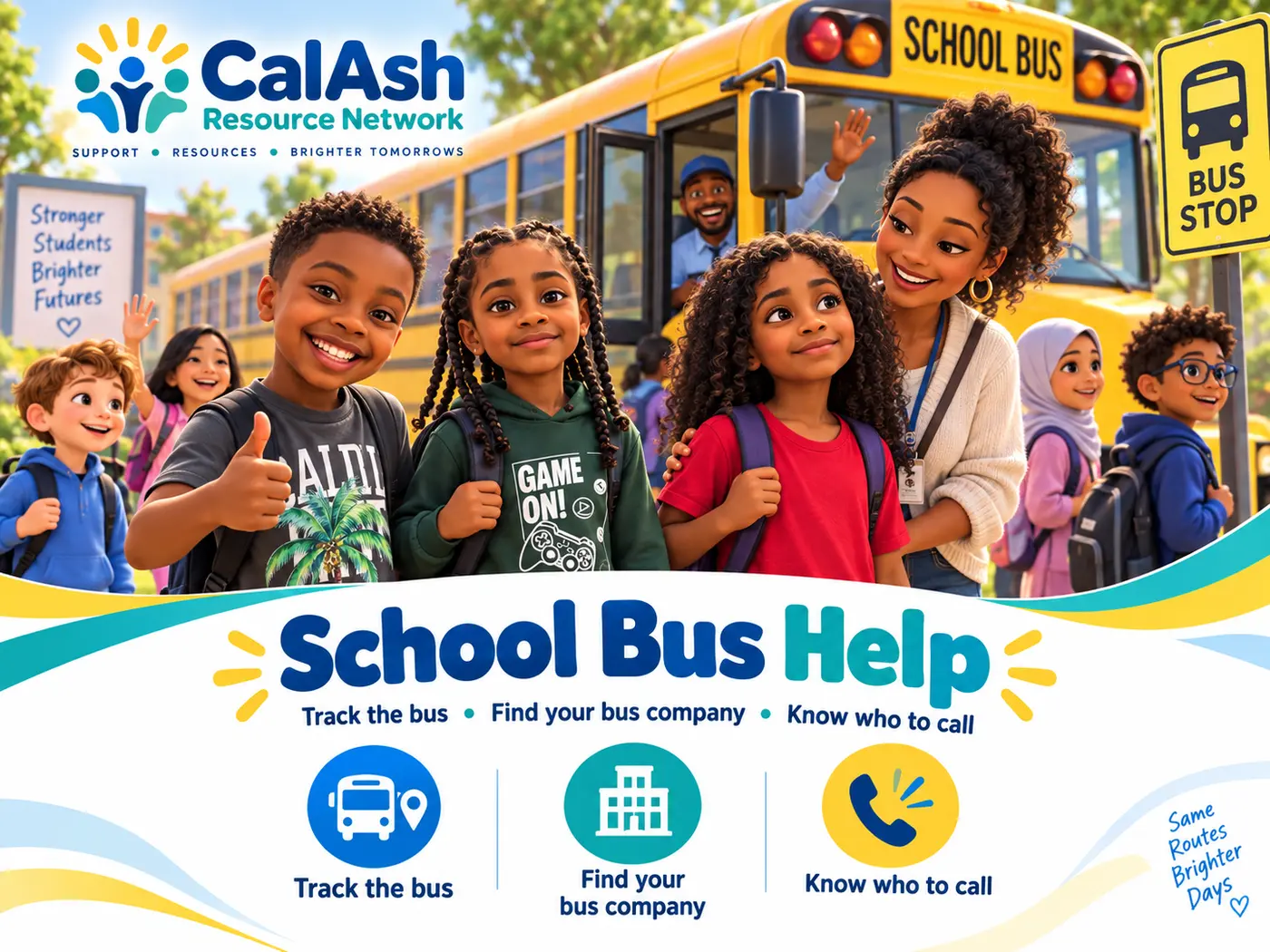
Need OPT? Call the Office of Pupil Transportation at 718-392-8855 for a complaint about the bus company, a safety concern or a bus emergency. Tell the school about repeated late or missed pickups.
Check the NYC School Bus App or your NYC Schools Account for available route information. If a bus does not appear in the app, the driver may not have logged in.
Call your assigned bus company using the official company directory. Ask whether the route is active and for an expected arrival time.
Contact your school's Transportation Coordinator. Ask for the expected pickup or drop-off time and whether a driver, attendant, paraprofessional or nurse is unavailable.
Ask the coordinator whether your child's circumstances qualify for NYCPS-paid alternative transportation. Confirm eligibility and the voucher process before paying for a ride if possible.
Record scheduled and actual times, who you spoke with, and any school, therapy, care or work disruption in the log below.
Parents may be at work, caring for other children or unable to drive. Tell the coordinator if you cannot provide substitute transportation. Do not assume a private ride will be reimbursed.
The bus did not come or is out of service
Call the bus company and school promptly. Ask if the route is out of service because of a driver or staffing absence, whether another bus is coming, and when. Ask the Transportation Coordinator about a qualifying LimoSys voucher or another safe plan. A substantial delay that becomes a verified no-show may have a separate reimbursement review for an eligible curb-to-school student; approval is never automatic.
If you cannot locate a child who was expected on a bus, call the bus company and school immediately; for immediate danger or a missing child, call 911.
Alternative transportation: LimoSys, personal vehicle and OMNY
NYCPS offers paid LimoSys rideshare for eligible students in specified circumstances, including an unassigned route, a route out of service because of driver absence, or a required IEP transportation accommodation or staff member not in place. Ask your school's Transportation Coordinator to confirm eligibility. The voucher code may appear in NYCSA or be supplied by the school. If eligible, use the NYCPS-paid option when available instead of paying first and hoping for reimbursement. Read current NYCPS rideshare rules.
Book eligible rides through LimoSys Tripslink or 212-426-8000. A person age 18 or older must accompany the child. The school must be the start or end point of the child’s school trip under NYCPS rules. Tell the coordinator if no adult is available to accompany your child.
Where a student and circumstance qualify, toll costs for a personal vehicle may be reimbursable with a toll receipt; do not assume mileage is covered. Check NYCPS personal-vehicle guidance.
Eligible students may receive a Student OMNY Card from their school. It allows up to four free rides daily, with applicable transfers, all day and through the school year and summer card period. Public transit may not meet a child’s safety or specialized transportation needs; speak with the school before changing a curb-to-school plan.
Can I get reimbursed for Uber, Lyft or car service?
Sometimes — not automatically. Current NYCPS rideshare rules specify eligible students and events: a route out of service because of driver absence, a delayed route assignment, or an IEP transportation accommodation or staff member such as a paraprofessional or nurse not in place. If the route is active and none applies, NYCPS says there is no rideshare reimbursement. A separate NYCPS reimbursement page says an eligible curb-to-school student whose substantial delay became a verifiable no-show may be considered. Ask your Transportation Coordinator which rule applies before paying whenever possible. A late bus alone does not guarantee payment.
For a qualifying private school trip, NYCPS lists a maximum of $100 per student per trip and $200 for the round trip in a day. Keep receipts showing the vendor, origin and destination, date, trip details and total cost. Tax and tips are not reimbursed. Reimbursement applies to actual qualifying trips to or from school and the current submission deadline is within one year of travel.
The bus is making my child late for therapy or care
Record missed or shortened ABA, OT, PT or speech; medical appointments; respite; after-school care; and any disruption to your work or caregiving schedule. Let the provider and school know what happened. This factual record helps show the impact if problems recur. It does not itself establish a right to rideshare or reimbursement.
For some students receiving specialized transportation, an alternate afternoon bus drop-off at therapy, childcare or an after-school program can be requested in advance through the NYCPS Transportation Overview and Support Hub link. Approval depends on route availability and location. NYCPS says changes generally take about 10 business days to take effect; same-day changes cannot be arranged after approval. Ask the school to help submit the request before scheduling a recurring drop-off.
Report a recurring or serious transportation problem
Send the school’s Transportation Coordinator a dated list of late pickups, no-shows, staffing issues, missed services and the bus company’s responses. Ask for a written plan and case or incident number. Use the NYCPS Transportation Support Hub to report and track the concern. For a bus company complaint or safety issue, call OPT at 718-392-8855. Review transportation rights.
Transportation problem log — save and download your records
Entries stay in this browser on this device. Download a copy to keep or share with your school. Avoid adding your child’s full name or medical details to notes on a shared device.
Immediate danger or a missing child: call 911 first. For an ongoing route or service problem, document dates and times, contact the school and transportation office, and ask for the issue to be escalated.
🧩🧩🧩
HOME SUPPORT FOR CHILDREN & FAMILIES
Find the right help at home.
Explore respite, pediatric home health, community support and CDPAP
for children with autism or developmental disabilities. Choose an
area and type of help below.
Respite & community support
Caregiver relief and help with play, outings, routines, safety and
everyday skills.
Pediatric home health
Nursing, therapy or approved personal care for children with
medical or daily-care needs.
CDPAP
If your child qualifies through Medicaid, your family can choose
and train a trusted worker.
Questions to ask before choosing support
Does the worker have experience with autistic children who need
lots of activity or close supervision?
Can the worker follow your child’s communication, AAC, sensory,
behavior, seizure and safety plans?
Will the worker join your child in play, movement, routines and
outings when appropriate?
Can the worker help with toileting, feeding or personal care if
those services are approved?
How are workers trained, screened and supervised? Is backup help
available?
Every child is different. Share your child’s needs clearly
and ask the provider to confirm that the specific worker is a good
match. Availability, approval and age limits can change.
TRUSTED CAREGIVER PATH
Can someone I already know become my child’s aide?
Sometimes a grandparent, aunt or uncle, adult sibling, cousin, family friend, neighbor or another trusted adult may be able to become a paid caregiver. The answer depends on your child’s authorization, the program and the agency’s rules.
Before anyone pays for training: Do not pay for HHA, PCA or CNA training until the home-care agency confirms which credential it accepts and whether the person you choose can be assigned to your child.
I already have someone I trust. What is the fastest route?
Find out why an aide is required.Ask whether the authorization comes through Medicaid, a managed-care plan, a home-care agency or a plan of care.
Ask whether you may choose the worker.Get the answer from the plan and the agency that will employ or pay the caregiver.
Ask for the minimum credential.It may be no certification, CDPAP, PCA, HHA or CNA. Do not send someone through HHA training if PCA is enough.
Confirm the person can be assigned to your child.Ask this before training starts. “We hire HHAs” does not automatically mean the agency will assign your chosen person to your child.
Complete training and onboarding.This may include a physical, TB screening, health clearance, background checks, registry steps and agency orientation.
Confirm the specific assignment.Ask for the start date, approved hours, pay, backup plan and who to call if the schedule changes.
PCA
Shorter personal-care training. It may be enough for some agency roles. Ask the agency first.
HHA
More extensive home-care training. New York’s core HHA curriculum is at least 75 hours and includes hands-on skills.
CNA
A broader healthcare credential. It is usually unnecessary solely for home care, but may support wider healthcare employment.
CDPAP
A Medicaid consumer-directed program, not regular agency HHA/PCA employment. The family recruits and trains the worker; traditional HHA/PCA certification is generally not required.
Important rule for children under 21: New York says a parent of a child younger than 21 cannot be that child’s CDPAP personal assistant. A spouse or designated representative also cannot be the paid personal assistant. Another eligible adult relative or trusted person may qualify, subject to the child’s authorization and current program rules. CDPAP now uses Public Partnerships LLC (PPL) as the statewide fiscal intermediary. Read the current NYS CDPAP information.
Agency-by-agency starting points
Call before training. If a detail is not published, CalAsh says so instead of guessing.
NYC · NASSAU · SUFFOLK
CareLink Home Care
Publishes HHA, PCA and CDPAP services. Its website says CDPAP participants can hire and train friends or family. Pediatric assignment rules, the minimum credential for a specific child, initial certification training, health-clearance steps, background checks, registry requirements, current pay and assignment timing are not publicly stated by CareLink.
Trusted person through CDPAP: published as possible, subject to current eligibility
Specific pediatric HHA/PCA assignment: confirm directly
Initial HHA/PCA certification training: not publicly stated
Publishes pediatric home care plus HHA and PCA services. Whether a family may bring a specific trusted caregiver, live-in rules, training, credential upgrades, pay and assignment timing are not publicly stated—confirm with the agency.
Publishes home-care employment and free caregiver training information. A current HHA certificate or qualifying PCA-to-HHA upgrade may be required for HHA roles. Pediatric placement and a guaranteed assignment to one specific child are not publicly stated—confirm before enrolling.
New York’s statewide CDPAP fiscal intermediary. Use PPL for current CDPAP registration and payroll steps after the Medicaid plan authorizes CDPAP. PPL does not replace the plan’s clinical eligibility decision.
Current New York HHA and PCA training starting points
Selfhelp Community Services
HHA + PCA · NYSDOH-approved · Free
Classroom instruction followed by a hands-on laboratory. The public page does not describe it as fully online. Training contacts include New York City and Long Island.
Publishes free English and Spanish HHA training with employment after successful completion. Locations and schedules vary; confirm the current Queens/NYC class before applying.
Publishes online lecture plus required in-person skills laboratory and an in-person clinical component. Day, evening and weekend schedules may be offered. Confirm tuition and the next dates.
Use the New York State list to confirm that a program is approved. Ask the school how much is remote, how many in-person days are required and whether the agency hiring your trusted person accepts that certificate.
Watch for misleading promises: CalAsh does not list “100% online HHA certification” as a safe shortcut. New York training includes supervised hands-on skills. Confirm approval with the state and the hiring agency.
PROBLEMS, COMPLAINTS & ESCALATION
When a school, program, agency or business is not helping
Start with the organization when it is safe to do so. Keep copies and move up one step at a time.
Document the problem.Write dates, names, what happened, what you requested and the response. Save emails, letters and screenshots.
Contact the organization.Ask for the problem to be corrected and request a written response.
Ask for a supervisor or administrator.State the solution you need and a reasonable response date.
Use the formal complaint, grievance or appeal process.Follow the school, plan, agency or business instructions and keep proof of submission.
Contact oversight or advocacy help.Use the official links below for schools, Medicaid, home care, healthcare and disability rights.
Consider legal or disability-rights help.Deadlines may apply, especially for school due process and insurance appeals.
Ask elected-official constituent services.This may help when a public agency is unresponsive or different systems are passing the family back and forth.
Consider media only for serious, systemic or repeatedly ignored problems.Protect your child’s privacy before sharing anything.
Media should not be the first step. It may help with a serious safety problem, discrimination, a systemic denial of services, an accessibility failure, a public-program failure or repeated documented complaints affecting many families that have been ignored.
Protect privacy: Do not automatically send a reporter a full IEP, Medicaid or insurance number, medical records, home address, school ID or identifying photos. Think carefully before publicly identifying your child. Once information is published or broadcast, it may be difficult to make private again.
Contacts last verified: September 2026
EVERYDAY CARE
Help with toileting and personal care
Find support for toileting, hygiene, continence supplies, respite
and daily routines at home or school.
DENTISTS · SPECIAL-NEEDS DENTAL CARE
Find dental care that can meet your child where they are.
Browse pediatric and special-care dentists across New York City, Long Island, the Lower Hudson Valley and North Jersey. Listings highlight disability experience, sensory support, sedation or hospital options only when the provider publishes that information.
Insurance participation can change. Please confirm coverage directly with the provider before scheduling. Ask about your exact plan, your child’s age, sensory accommodations, desensitization visits, sedation, hospital dentistry, communication needs and behavior support.
CHILDREN’S HEALTH
Find a specialist for your child.
Search for developmental pediatricians, child psychiatrists and psychiatric nurse
practitioners, psychologists, ADHD specialists, pediatric epilepsy
teams and feeding therapists.
Feeding concerns can have many causes, so ask for a complete
evaluation.
Before you schedule: Ask whether the provider works with
nonspeaking children, AAC users, sensory needs, intellectual
disabilities and children who may need testing changes.
For a seizure emergency: Follow your child’s seizure action
plan and use emergency medicine exactly as prescribed. Call 911 when
the plan tells you to.
Check insurance: “Medicaid listed” means the office or health
system lists Medicaid. It does not guarantee that every doctor,
service or location is covered. Confirm with the office and your
insurance plan. Insurance participation can change. Please confirm coverage directly with the provider before scheduling.
NEW YORK HOSPITAL NETWORKS
Search by hospital network.
Browse developmental, autism, ADHD, epilepsy, feeding and
neuropsychology services. Each listing reminds you to confirm
insurance before making an appointment.
Developmental pediatricsAutism evaluationsNeuropsychology + ADHDPediatric epilepsyFeeding + rehabilitationInsurance information
🧩🧩🧩
ABA & FAMILY TRAINING
Find ABA support at home, in a clinic or in the community.
Ask about goals that help your child and family, such as
communication and AAC, safety, toileting, daily routines, community
activities and caregiver coaching.
FEATURED VERIFIED RESOURCE
Proud Moments ABA — Queens & Long Island
Ages 0–21 · in-home ABA · check current availability
Insurance plans listed on the provider’s Queens page:
Horizon, Aetna, CareFirst, MagnaCare, Healthfirst, Beacon (including
Emblem), NYSHIP, The Empire Plan, MVP, Fidelis, Cigna, Sovereign
Nations, Tricare and Child Health Plus, plus most major private
plans.
Confirm your exact plan, costs, approval requirements and current
openings directly with Proud Moments and your insurance
company.
HAIR CARE THAT RESPECTS YOUR CHILD
Find sensory-aware haircuts, braids and grooming help.
Choose an area and the kind of support your family needs. “Sensory-aware” means the provider lists accommodations or special-needs experience; always call before booking to explain your child’s needs.
Before booking: ask who will work with your child, whether breaks are okay, what sounds or tools to expect, whether a caregiver can stay close, and how the provider handles movement, communication and distress. A directory listing is not a guarantee of fit.
PAY LESS · BORROW · APPLY · GET HELP
Free and low-cost help for everyday needs.
Start with the type of help you need. These buttons open matching resources in the main directory, including public programs, reimbursement, equipment loans, Medicaid supplies, school help and grants.
Rules, funding and availability can change. Ask for approval before buying an item if you hope to be reimbursed, and never pay anyone who promises guaranteed grant money.
ASK FOR HELP SAFELY
Share the problem—not your child’s private information.
Do not post: your child’s full name, home address, school ID, Medicaid number, insurance ID or a full IEP.
Safer wording: use your child’s age range, borough or county, and the kind of help you need.
Remember: advice from other families can be helpful, but it is not medical, legal or benefits advice.
PARENT Q&A
Ask a question. Read a helpful answer.
Browse privacy-safe questions and practical answers. Use the category buttons to find a topic. You can also send a question privately for Sophia to review before it appears here. Medical, legal and benefits decisions should always be confirmed with the right professional.
Protect your child’s privacy. Do not share full names, addresses, school IDs, Medicaid numbers, insurance numbers or full IEPs in any public group. Questions sent through this form go to private review first. Sophia can edit, answer or decline them. CalAsh messages are not monitored continuously; allow 24–48 hours for a response.
COMMUNITY IS PART OF CARE
Children need places to play, move and belong.
Support is also about enjoying life outside appointments. Find local
outings, sensory-friendly activities, travel options and programs
where families can participate together.
Find free neighborhood outings, discounted admission, and paid trips.
Choose what fits your family and check the total cost and support
available before you go.
A free pass may require a library card, application or reservation. Travel, food, parking and extra guests may cost more.
Staffed support Hands-on help is availableAutism-trained Trained staff and planned
accommodationsSensory access Quieter spaces, guides or sensory toolsCall first Ask what help is available before you go
SENSORY-FRIENDLY TIMES
Quieter times for family outings
Schedules and participating locations can change. Check the
location’s website or call before leaving home.
Important: “Sensory-friendly” does not mean every child will
be comfortable. Ask about crowds, music, lighting, waiting lines,
quiet spaces, bathroom access and exit/re-entry rules.
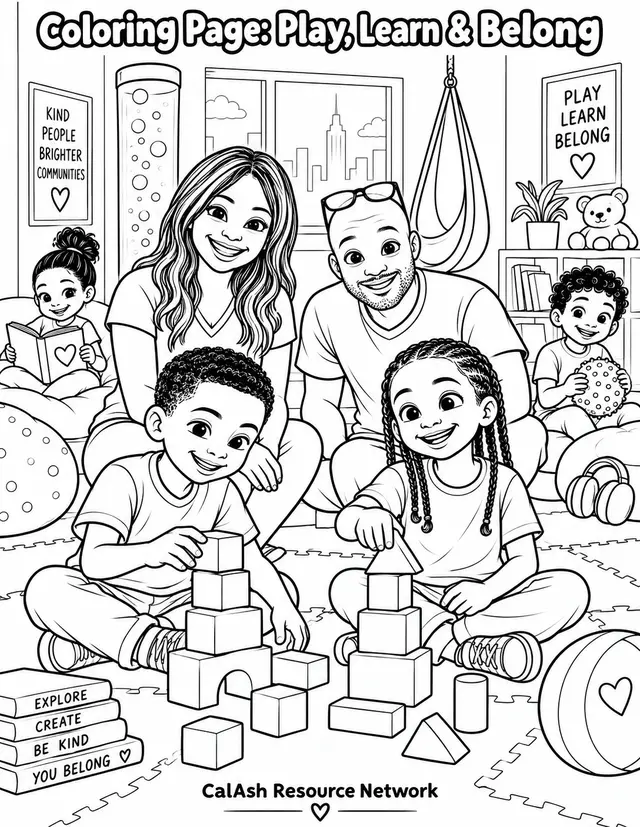
FREE · PRINT AT HOME
Print & Play
Simple activities with clear lines and plenty of open space. There
is no right way to color—let your child choose what feels fun.
Start with one page. If your child is not interested, skip it—these
are optional activities, not therapy or homework.
YOUR LANGUAGE MATTERS
Helpful information should feel understandable.
Browse family and children’s videos in English, Spanish, Haitian
Creole, Chinese, Bengali, Arabic, Urdu and more. When a provider
does not list your language, ask whether an interpreter is
available.
Choose who is watching and a language. These links were selected for
respectful, child-friendly learning. Start with a short clip and
watch with your child the first time.
Use the sensory notes. “Lively” may include songs, faster
movement or brighter scenes. “Gentler pace” may be easier for some
children. Every child is different, so preview first and stop if the
video is uncomfortable. Language note: Labels describe the
spoken language or translations provided by the publisher. Automatic
captions are not counted as a verified translation.
CARE THAT CONNECTS
Therapists who see the whole child
Find professionals who partner with families, respect
communication differences and make room for joy.
MORE THAN APPOINTMENTS
Kids living their lives
Support is not about changing who a child is. It is about helping
families access school, community and everyday life.
RESOURCE DIRECTORY
Resources for your family
Your Saved ResourcesSaved on this device. Print or share names, locations, phone numbers, links and questions to ask.
No exact matches yet
Try removing a filter or searching a broader term.
MEET THE FOUNDER
Why CalAsh Exists
CalAsh started because finding help for my own children was harder than it should have been. I was constantly searching for schools, therapies, doctors, dentists, activities, services and everyday resources — and too often the information was scattered, outdated or difficult to understand.
I wanted one place where families could find the things they have to deal with, like IEPs, Medicaid and therapy, along with the things that make family life better — a good barber, a sensory-friendly outing, a vacation, a camp, or simply somewhere your child can have fun and be included.
CalAsh combines my sons’ names, Caleb and Asher. I built it for them, but also for every family who has ever thought, “Why is this so hard to find?”
Help should be easier to find. That’s what CalAsh is here for.
Parent-built Practical questions families actually askRegionally focused NYC, Long Island, the Lower Hudson Valley & North JerseyInclusive Different languages, cultures and support needs
For family privacy, personal contact information and details about the founder’s children are not published.
Ask whether staff have worked with families from your community,
whether someone speaks your preferred language and how your family’s
culture and priorities will be included in your child’s care.













 Sensory needs
 Travel & passports
 Print & Play
 Videos & languages