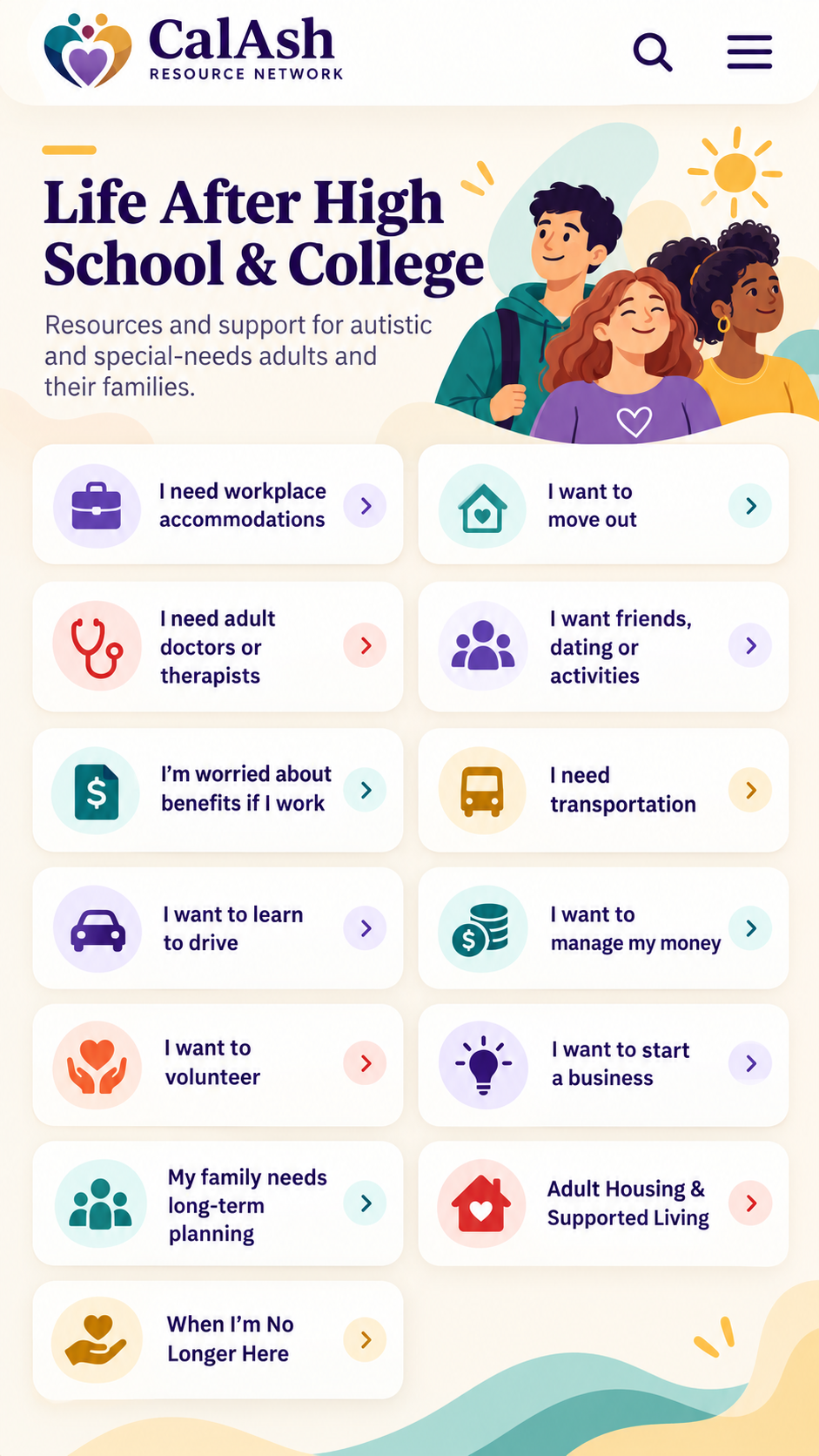
Resources and support for autistic and special-needs adults and their families.
Work, independence, adult services and everyday life after school ends. Choose the next step that fits you—after high school, trade school, college or graduate school, while working, or with substantial lifelong support. Autism does not set an educational or career ceiling.
Gather your IEP transition documents, work and volunteer history, accommodations that helped, and contact details for adult-service agencies. Ask the school who will help with the handoff and whether vocational rehabilitation, OPWDD in New York or DDD in New Jersey fits your goals and eligibility. Your next step can be college, trade training, work, supported employment, community programs or a mix.
NY · vocational rehabilitation for eligible people whose disability affects work; counseling, training and placement are planned around an employment goal.
Next step: Apply and meet a counselor to build an Individualized Plan for Employment.
Essex County · public community college admissions.
Next step: Ask admissions about program prerequisites, cost and disability services.
I just graduated college
Degree-holder career toolkit
Use the degree and experience you already have. Search degree-related entry roles, fellowships, internships, trainee programs, professional associations and alumni job boards. Compare salary, insurance, schedule and advancement, then track applications, interviews and references. A bachelor’s or advanced degree does not automatically make you ineligible for ACCES-VR or DVRS; the agencies assess disability-related employment barriers and individual goals.
Interview and disclosure
Ask for clear written instructions, a quieter or remote interview, or reasonable processing time when needed. Telling an employer you are autistic is a personal choice. To request an ADA accommodation, you generally must tell the employer enough about the disability-related need; you do not have to tell coworkers. See EEOC guidance and JAN examples.
At work and beyond
Possible supports include written tasks, predictable schedules, quieter space, noise reduction, task tools, communication preferences, flexible breaks, adjusted training or remote/hybrid work when compatible with the role. If underemployed, ask about a promotion plan, certification, mentorship, career change or graduate study. Plan for email, commuting, task switching, sensory load and burnout. Freelance or business income also warrants tax and benefits advice.
College graduate action checklist
Update resume and cover-letter examples
Update LinkedIn or portfolio
Contact college alumni/career services
Identify five to ten target employers
Explore civil-service careers
Apply for vocational support if needed
Review accommodation options
Request benefits counseling if receiving disability benefits
Join a professional organization
Practice interviews and mock interviews
Research salary ranges
Build a 30/60/90-day career plan
Explore government and civil-service vacancies or use your college’s current career and alumni portals. Use your degree, internship projects and strengths to choose a career direction. Ask about job-search support, interview accommodations, professional networking, graduate study or career advancement. A college credential does not disqualify someone from exploring disability-related employment supports when otherwise eligible.
NY · for qualifying recent law, graduate or professional school graduates; state agency assignments. Read the current application cycle and degree requirements.
US · a private job platform designed for neurodivergent jobseekers; listings and employer participation vary. Create a profile and review each posting’s qualifications.
US · free accommodation guidance for applicants and employees.
Next step: Compare interview, onboarding, sensory and executive-function ideas before requesting a specific change.
I finished school without a traditional diploma
Completing a transition program, earning an alternate credential or aging out can lead to work, training, community participation and a full adult life. College is one option, not the measure of success. Ask the school for a transition summary and confirm adult-service eligibility before school ends.
New York · for OPWDD-eligible adults · Pathway to Employment, the Employment Training Program and supported employment offer different routes toward paid work.
Next step: Ask a care manager which service fits the adult’s interests and support needs.
New Jersey · public vocational rehabilitation · Employment assessment, an individualized employment plan, training or supported employment as appropriate.
Next step: Contact the local DVRS office and bring documentation of employment barriers.
New Jersey · DDD-eligible adults · Day habilitation, community-based supports and employment services can be combined around individual goals.
Next step: Ask the support coordinator about options, provider choice and transportation.
I need help finding a meaningful day
Adults deserve choice, purpose, friendships, activity and community, whether or not conventional work is the immediate goal. A structured program can help, but it is not the only option. Build a week around the adult’s interests and support needs.
New York · Medicaid-funded for eligible people · Individualized support for cooking, shopping, travel, social participation and daily-living goals at home and in the community.
Next step: Put personal goals in the Life Plan and ask the care manager about providers.
Lower Hudson Valley · listings vary · Search community volunteering by place, interest and availability. Volunteering can complement, not replace, appropriate paid work.
Next step: Contact a listing to ask about accessibility and support arrangements.
Looking for work, training or job coaching
In New York, ACCES-VR can assess eligibility for vocational counseling, education/training and employment support. OPWDD describes Pathway to Employment, the Employment Training Program and supported employment for eligible people. In New Jersey, DVRS offers vocational counseling, job placement, supported employment and job coaching; DDD employment services may follow the DVRS process for eligible waiver participants. Ask about the individual plan, provider and any waiting period.
Federal · current vacancies including professional and trainee roles.
Next step: Create a profile and save searches; check eligibility and required documents in each announcement.
I have a job but need support
Describe the actual task or situation that is difficult: training, schedule, communication, sensory environment, transportation or keeping the job. Ask the employer about an accommodation and speak with your vocational counselor or support coordinator about job coaching or employment retention when eligible. Keep a record of what works.
NJ · eligible waiver participants may access supported employment after DVRS referral.
Next step: Ask the support coordinator to put the work goal in the service plan.
I want to advance my career
Consider new credentials, mentoring, promotion, changing fields or graduate study. New York ACCES-VR describes help to advance or regain employment for eligible applicants; New Jersey DVRS can help develop a career pathway. Your goals should be individualized, not limited to entry-level work.
US · accommodation ideas for task switching, communication, sensory settings and work organization.
Next step: Request concrete changes that address the barrier to promotion or retention.
Vocational and trade training
Compare certificates, apprenticeships, community-college programs and supported on-the-job training. Ask whether the program teaches the skill you want, provides accommodations and has a realistic path to employment. Discuss funding with ACCES-VR or DVRS before enrolling if you seek their support.
US · searchable registered apprenticeship opportunities, including paid work-based training.
Next step: Search by occupation and location; verify each sponsor’s entry requirements.
Workplace accommodations
Identify the barrier and a practical change: written instructions, quieter space, predictable schedule, communication tools, flexible breaks or assistive technology. Ask your employer or vocational counselor how to request and evaluate an accommodation. You can ask for help without sharing every detail of your diagnosis with coworkers.
Options include an apartment with supports, living with family, shared living, supervised apartments and higher-support residential settings. Compare rent, subsidy eligibility, staffing, transit, safety, relationships and the ability to make ordinary life choices. No one housing model fits everybody.
US · rental assistance through local public housing agencies, subject to eligibility and availability.
Next step: Find the housing authority for the desired county and ask about open applications.
Adult doctors and therapists
Ask pediatric providers for a transition summary, medication list and referrals before care ends. Confirm age limits, insurance, accessibility, communication needs and whether a caregiver may participate with your consent. Bring a brief health profile to new appointments.
NYC · adult primary and specialty care, dentistry and behavioral health with experience serving people with I/DD. Check locations, insurance and availability; appointments: 212-273-6272.
NJ · general adult primary care and behavioral medicine. It is not presented as an autism specialty clinic; ask directly about communication accommodations and insurance.
Friends, dating and adult social life
Build life around interests: sports, gyms, art, music, gaming, cooking, travel, community events, adult camps, social groups or dating and relationship programs. Ask whether a program is age-appropriate and whether communication, transportation or support needs can be accommodated. Friendships and choice matter alongside services.
NYC five boroughs · art community for people with autism or other I/DD; currently virtual sessions. Documentation of I/DD is required; contact artsandculture@yai.org.
Bergen/Passaic NJ · adult I/DD day programs and recreation calendars. Call (201) 358-8000 to ask about eligibility, tours and costs.
Benefits and work
Earnings can affect SSI, SSDI and Medicaid differently. Get individualized benefits counseling before turning down a job or assuming benefits will end. Social Security’s Work Incentives Planning and Assistance program explains work incentives for eligible beneficiaries; NJ DVRS also offers benefits counseling.
US · official information on SSI/SSDI work rules and reporting.
Next step: Keep pay records and ask a counselor to review your exact benefits and Medicaid situation.
Transportation
Map the actual trips to work, school, health care and friends. Compare fixed-route transit, paratransit eligibility, travel training, rides from trusted people and accessible options in your area. Practice a backup route and check fares before committing to a program.
NJ · accessibility information for bus, rail and light rail.
Next step: Plan the actual commute and check station accessibility.
Learning to drive
Ask a licensed instructor or driving rehabilitation specialist whether standard lessons or an individualized evaluation is appropriate. Consider attention, sensory needs, executive functioning, medication effects and adaptive equipment without assuming a person cannot drive because of a diagnosis.
NJ · vocational rehabilitation can evaluate transportation needs tied to an employment goal.
Next step: Raise commuting and any adaptive-driving question at intake.
Managing my own money
Practice banking, budgeting, bills, online safety and recognizing scams with supports that preserve choice. An ABLE account or benefits-aware savings strategy may be relevant, but ask a qualified adviser about eligibility and consequences.
US · information on state ABLE plans and eligibility; plan rules vary.
Next step: Compare plan fees, qualified expenses and benefit effects before opening.
Volunteering
Choose a cause and schedule that fit your interests. Volunteering can build community and skills, but it should not replace paid work when that is the goal. Ask about transportation, a point of contact and any needed accommodations.
US · service roles with program-specific requirements and benefits.
Next step: Search current opportunities and read the specific position terms.
Starting a business
Test the idea, costs and customer demand; choose supports for planning, bookkeeping and accessible work practices. Ask a vocational counselor whether self-employment support is available under your individualized plan, and get benefits advice before income changes.
US · benefits counseling for eligible recipients considering business income.
Next step: Get a personalized review of self-employment earnings and reporting.
Government & civil service careers
Public jobs include IT, cybersecurity, data, communications, finance, HR, procurement, social services, planning, public health, libraries, engineering, investigations, administration and skilled trades. Search a real vacancy first, check minimum qualifications and the application deadline, then select the standard exam route or a disability hiring route where eligible. These routes do not guarantee a job.
Qualified people with certified disabilities may be appointed to certain eligible competitive-class positions without the normal exam if they meet job requirements. Follow DCAS certification and job-application instructions.
Separate state programs for eligible individuals and veterans with disabilities. Review certification and submit a candidate profile for consideration; positions remain competitive on qualifications.
County, city, town and village civil-service employers may use eligible local 55-a positions. Contact the relevant local civil-service agency; the NYC and state programs are distinct.
Nassau, Suffolk, Westchester, Rockland, Putnam and Orange · local agencies publish separate exams and vacancies.
Next step: Choose the county or municipal civil-service agency, check live postings and whether local 55-a applies.
Long-term planning with my family
Plan for housing, health care, money, relationships, support people and what happens if a caregiver becomes unavailable. Include the adult’s preferences and communication method. Build independent oversight and update the plan as life changes.

Friends, dating and adult social life
Build life around interests: sports, gyms, art, music, gaming, cooking, travel, community events, adult camps, social groups or dating and relationship programs. Ask whether a program is age-appropriate and whether communication, transportation or support needs can be accommodated. Friendships and choice matter alongside services.
Real places to start
NY · for eligible people, community habilitation, recreation and self-direction can support chosen activities.
Next step: Ask your care manager which local providers and budgets fit the adult’s interests.
NJ · eligible waiver participants can seek enrichment and recreation in their service plan.
Next step: Ask the support coordinator about a community inclusion provider and age-appropriate activities.
NY/NJ service area · museums, sports, arts and family activities in the existing directory.
Next step: Filter by place and interest; confirm adult access and costs.
NYC tri-state · autistic-led adult community with in-person and online events. Check the current calendar and participation details.
NYC five boroughs · art community for people with autism or other I/DD; currently virtual sessions. Documentation of I/DD is required; contact artsandculture@yai.org.
Manhattan · social and dating skills for OPWDD-eligible adults 18+ living with family in Manhattan. Use YAI’s Get Started form.
Nassau/Suffolk · group recreation for OPWDD-eligible adults 21+ living with family. Ask YAI about enrollment and current activities.
Rockland · community outings for OPWDD-eligible adults ages 18–28 living with family. Submit YAI’s Get Started form.
Bergen/Passaic NJ · adult I/DD day programs and recreation calendars. Call (201) 358-8000 to ask about eligibility, tours and costs.